
Chu WY, Chan LC, Cheung HM, Leung KL, Ng PC, SO CT, Chan TM, Chan YL, Chau SL, Fung A, Leung SN an Lui NE. Focus Group of Respiratory Care, Hong Kong Occupational Therapy Association
In the Guide to Public Transport for People with Disabilities, first published in 1993, Transport Department had clearly stated its commitment to facilitate people with disability to use public transport services1. Yet, patients on oxygen therapy in Hong Kong have not yet been benefited from such commitment up till now.
Since 1980s, home oxygen therapy has been the standard of care for managing chronic severe respiratory conditions, allowing more and more indicated patients to be cared in the community nowadays. In Hong Kong, compressed oxygen cylinders for medical use are supplied by medical gas manufacturing companies with licences granted and monitored strictly by the Fire Services Department. At present, there are 5,000 to 6,000 oxygen users living in our community, consuming 40,000 to 50,000 compressed oxygen cylinders every year. However, major incidents have not yet been reported.
As mentioned in the Provision and Use of Transport Vehicles from DDA of UK 2, it is the duty of the transport providers to perform reasonable adjustments to make their services accessible to disabled people. The Code of Federal Regulation in USA also clearly states that the transport provider shall not prohibit an individual with a disability from travelling with respirator or portable oxygen supply3. In some developed countries, guidelines are established for travelling with medical oxygen, 4,5 or with provisions of exemptions in transporting compressed oxygen cylinders 6. In Hong Kong, oxygen users will be denied to access public transportation when they carry compressed oxygen cylinders for their intrinsic medical needs. By law, compressed gas cylinders are classified as dangerous goods7 and thus prohibited from conveying on board8.
A survey was conducted in our local community to assess the profile of needs in using public transportation services by oxygen users with the ultimate aim to improve public awareness towards the difficult situations that they have been facing. This survey was conducted from July to August 2009 (fig. 1). From the lists provided by the 5 major oxygen vendors, active oxygen users were invited to participate in this study. 475 questionnaires were successfully completed by telephone interviews.
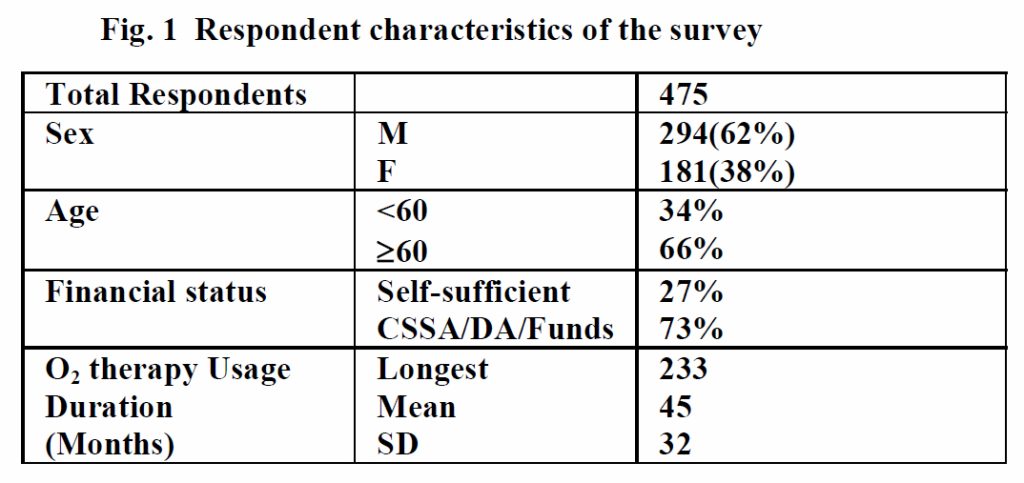
Over 84% of the respondents considered use of public transportation services as a fundamental need in daily life. Nearly all respondents (n=460) reported the need to use various public transportation services in their usual daily activities. Many of them (n=254) had to rely on taxi as their chief transportation medium but lamentably, most experienced genuine financial hardships (73% rely on CSSA/DA/other public funds). While many oxygen users were using public transport services to attend medical follow-ups (n=334), a significant portion also required public transportation to perform other daily activities (n=355) (fig. 2).
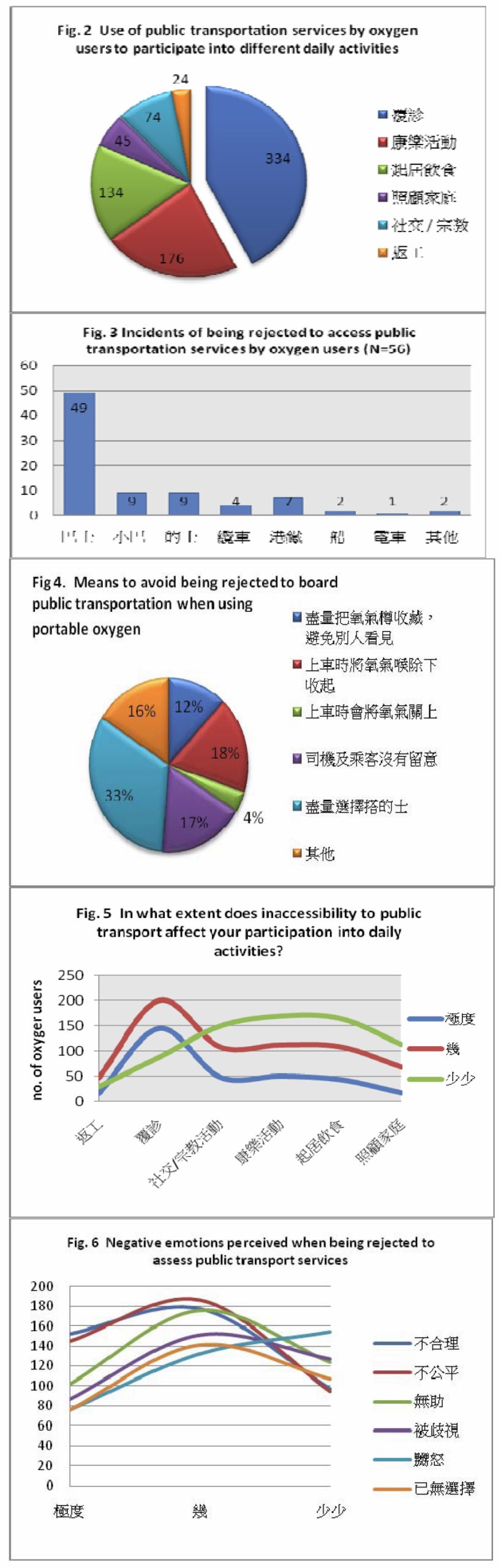
The figure might seem low (11.8%) for oxygen users reported actual incidents of being denied to board (fig.3). However, those who fled were either using different means to hide themselves from using portable oxygen (fig.4) or not using it at all while on board. Actually, many oxygen users (71%) were not be able to use portable oxygen on a regular basis when taking public transportation. The revealed figure was disturbing and should raise alarming concerns to their bodily needs.
Barrier to access public transportation has evidently induced difficulty of various extents for oxygen users to participate in different daily activities (fig.5). From their perspectives, the barrier to reintegrate into the community was rooted so much within the current policy and the rigid practice of public transportation services.
Apart from having safe services, provision of accessible and affordable transportation to all is also a duty the public transport sector cannot shun. It is disappointing to see the current policy continues to abide by ordinances conservatively set before 1980s5. Even worst is that the local public transport sector is using these ordinances to escape from its basic social responsibility of offering reasonable accommodation for persons on oxygen therapy. Raging with emotional distresses (fig.6), most oxygen users (80.6%) are urging to resolve this deadlock they have put up for a long time.
Transport for “all” is attainable in Hong Kong if the policy makers can initiate a fair review on the existing policies and practices. Collaborations with public transport and other stakeholders would be necessary to work out safe, practical and sustainable solutions so that a more inclusive society would be enjoyed by all in an equitable manner.
References
- 運輸署(2005),《殘疾人士公共交通指南》,香港特別行政區政府物流服務署。
- Disability Rights Commission, 2006, Supplement to Part 3 Code of Practice: Provision and Use of Transport Vehicles, in Disability & Discrimination 2005, United Kingdom.
- National Archives of Records and Administration 1985 (updated 1 Oct 2002), Transportation Services for Individuals with Disabilities (ADA), Code of Federal Regulations, Title 49, Subtitle A, Part 37.167(h). Retrieved 7 Oct 2009 from http://www.gpoaccess.gov/topics/transportation.html
- European Industrial Gases Association 2007, Planning Oxygen Supplies for Respiratory Patients when Travelling. Retrieved 23 Mar 2009 from http://www.eiga.org
- CountryLink, Rail Corporation New South Wales, Australia. Retrieved 23 Mar 2009 from http://www.countrylink.info/travelling_w_us/special_needs
- Special Reminder of a Few Exemptions Provided for in the Transportation of Dangerous Substances Regulation, bulletin 06.07.03, updated July 8 2003, Transport Canada.
- 《危險品條例》(第295B章),1997年6月30日版本;2009年3月23日更新自http://www.legislation.gov.hk/eng/home.htm
- 《公共巴士服務條例》(第230A章),1997年6月30日版本;2009年3月23日更新自 http://www.legislation.gov.hk/eng/home.htm
“Perspectives” is a column where views from members concerning respiratory medicine can be channelled. Submissions can be directed to the Editor. Published materials represent the views of the authors only and the Editorial Board retains the right of selecting, reviewing and editing the submissions where appropriate.
Related article: Dr. TAM Cheuk Yin, President & Dr. Maureen ML WONG President, Hong Kong Thoracic Society American College of Chest Physicians (HK & Macau Chapter). Access to Public Transport for Persons Requiring Supplementary Oxygen Therapy, 26 November 2009 (Link here)